


Skill-Based Recruiting: Why Capabilities Matter More Than Credentials
- Marcus

- Dec 14, 2025
- 4 min read
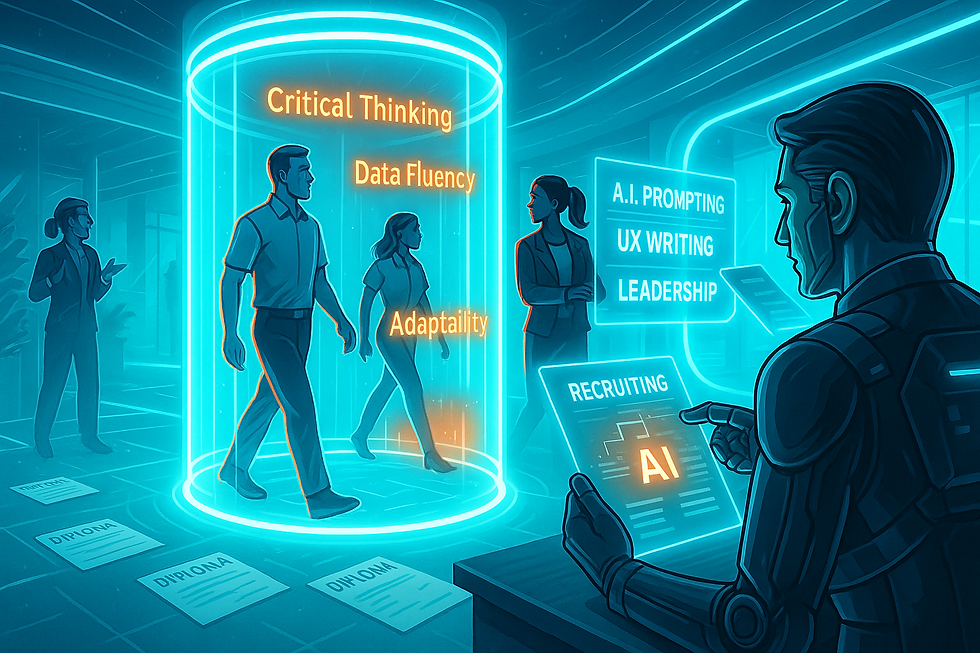
In recruiting circles, terms such as “skill-based hiring,” “skills-first recruiting,” or “competency-based selection” are gaining popularity. Many organizations see this as the key to fairer hiring, better matches, and broader access to talent.
But what’s really behind it — and where are the hidden pitfalls?
What Is Skill-Based Recruiting?
Skill-based recruiting shifts the focus from “what you are” — your degree, title, or job history — to “what you can actually do.”
Instead of relying on traditional CVs or certificates, selection focuses on:
Competency or skills profiles
Task-based assessments or work samples
Real-world and methodological skills
Soft skills and behavior in authentic scenarios
A recent study on AI and Green Job postings found that between 2018 and 2023, job ads requiring formal degrees decreased by around 15%, while demand for concrete skills rose significantly. (“Skills or Degree? The Rise of Skill-Based Hiring for AI and Green Jobs,” Bone, Ehlinger & Stephany, Oxford Internet Institute, 2024 — arxiv.org/abs/2312.11942)
Skill-based hiring is not just a buzzword. It’s a pragmatic response to rapidly changing industries, where specific skills now outweigh traditional career patterns. So, what makes this approach attractive for organizations—and what should you watch for?
The Advantages
The model offers several compelling benefits:
A wider talent pool and more inclusion
Focusing less on formal credentials opens doors to career changers and candidates from non-traditional backgrounds.
Better matches, fewer mis-hires
Evaluating real abilities instead of paper qualifications narrows the gap between expectations and actual performance.
More diversity and equal opportunity
Reducing reliance on degrees minimizes educational and social privilege in the hiring process.
Agility and adaptability
In fast-moving fields, skills can be updated more quickly than academic credentials.
More objectivity, less bias
Structured assessments with clear criteria can improve decision consistency.
The Drawbacks You Shouldn’t Ignore
The transition sounds easy, but it brings serious challenges:
Questionable test validity
Poorly designed skill tests can be misleading. Many “skills-first” systems rely on unvalidated or inconsistent assessments.
Limited real-world evidence
Even when companies drop degree requirements, only a small share of hires actually come from non-degree candidates — the effect is often marginal.
Legal and compliance risks
Assessment methods must meet standards of anti-discrimination and fairness. Poor design can have legal consequences.
High initial effort
Building skill frameworks, test libraries, and training programs requires significant upfront investment.
Overweighting hard skills
An overemphasis on technical competence can undervalue the importance of communication, empathy, and cultural alignment.
The “Voodoo Recruiting” trap
When hiring managers replace degrees with vague impressions, “skills-based” quickly becomes “guess-based.”
What It Takes to Make It Work
Skill-based recruiting succeeds only if the organization sets the right foundation:
1. A clear skill framework
Define which skills truly drive success in each role — and categorize them (hard, soft, tools, methods).
2. Validated assessments
Only evidence-based, role-relevant exercises — such as coding challenges, case studies, and simulations — produce meaningful data.
3. Bias reduction through standardization
Consistent rating scales, anonymized screening, and diverse interview panels enhance fairness.
4. Transparency
Candidates should understand which skills are being assessed and how they can prepare for them.
5. Data & systems integration
Skill data must link seamlessly to ATS and HRIS platforms for long-term use.
6. Change management
Managers and recruiters must adapt their mindset. For many, “skills-first” feels like a Cultural Revolution.
7. Continuous validation
Skills evolve — your framework and testing need to evolve, too.
Common Pitfalls
Even with good intentions, execution can go wrong:
Skill definitions that are too broad (“team player”) or too narrow (“expert in Excel pivot macros”)
“Assessment overload” that frustrates candidates
Tests disconnected from real job demands
Lack of buy-in from hiring managers
Data silos between HR systems
Overemphasis on hard skills, neglecting interpersonal ones
Resource strain when scaling across many roles
Spotlight: Work-ID — a Swiss Startup Reinventing Skills Transparency
An exciting example comes from Switzerland: Work-ID, founded by Cornel Müller and team. Work-ID has developed a digital skills passport — a verifiable, privacy-controlled record of a person’s capabilities, experience, and values. Candidates can share this “Work-ID” with employers to be discovered based on skills rather than CV keywords.
At the same time, Work-ID is developing a Skills Manager tool for employers — a dashboard that visualizes both internal and external skill data to identify talent gaps, assess mobility potential, and match quality. Its freemium model and low integration barrier make it appealing for mid-sized companies in the DACH region. The concept is simple yet powerful: transparency, standardization, and control for both sides of the labor market.
How to Get Started: A Practical Roadmap
Start small – Pilot one role with clearly measurable skills (e.g., developer, data analyst).
Define a skill framework – Identify 10–20 core skills that drive performance.
Design role-relevant assessments – Use real-world tasks, not abstract tests.
Set scoring logic – Balance technical and behavioral skills.
Integrate systems – Connect skill data with your ATS and talent pool.
Validate continuously – Compare predicted performance against actual results.
Train & communicate – Coach hiring managers and recruiters on the approach.
Scale thoughtfully – Expand to more roles and keep frameworks up to date.
Final Thoughts
Skill-based recruiting is more than another HR fad. It’s a necessary response to shifting labor markets, evolving career paths, and the growing demand for fair, evidence-driven hiring practices. Yet it’s no silver bullet. Success depends on clear skill definitions, sound assessment design, leadership alignment, and robust data integration. The Work-ID example shows how transparency and simplicity can make “skills-first” hiring scalable.
Key takeaways: Skill-based recruiting enables fairer, more effective hiring. Success requires clear skill definitions, sound assessments, leadership support, and robust data integration. The approach finds talent based on real abilities, not just past credentials.


Comments